The pay revision commission plays a crucial role in shaping the salary structure of employees, especially in the public sector. Whenever discussions around salary hikes, allowances, or wage restructuring arise, the pay revision commission becomes the central point of reference. This article explains what it is, how it works, and why it matters to employees and the economy.
What Is a Pay Revision Commission?
A pay revision commission is a government- or organization-appointed body responsible for reviewing and recommending changes in salary structures, allowances, and service conditions of employees.
Its primary objective is to ensure that wages remain:
- Fair and competitive
- Aligned with inflation and cost of living
- Sustainable for the employer or government
Such commissions are commonly formed for government employees, public sector units (PSUs), and large institutions.
Why Salary Revision Committees Are Formed
Instead of frequent ad-hoc salary hikes, authorities rely on structured reviews. These committees help bring uniformity, transparency, and financial discipline.
Key Reasons for Formation
- Rising inflation and living costs
- Changes in economic conditions
- Need to retain skilled workforce
- Parity with private sector pay standards
This structured approach ensures long-term planning rather than short-term fixes.
How the Pay Revision Process Works
The functioning of a pay revision commission follows a defined process that includes research, consultation, and analysis.
Stages Involved
- Data collection on current salaries and benefits
- Economic assessment including inflation, GDP growth, and fiscal capacity
- Employee representations from unions and associations
- Comparative studies with previous revisions and other sectors
- Final recommendations submitted to the authority
Once approved, these recommendations are implemented with a fixed effective date.
Who Benefits from Pay Revisions?
Pay revisions are not limited to basic salary increases. Their impact extends across multiple components of compensation.
Major Beneficiaries
- Government employees
- PSU and autonomous body staff
- Pensioners (through revised pension formulas)
- Contractual employees (in some cases)
Revised pay structures often lead to improvements in allowances, retirement benefits, and job satisfaction.
Difference Between Pay Revision and Pay Commission
Although often used interchangeably, there is a technical difference.
| Aspect | Pay Commission | Pay Revision |
|---|---|---|
| Scope | Broad, nationwide | Organization or sector-specific |
| Frequency | Usually 10 years | 5–10 years |
| Coverage | Government employees | PSU, banks, institutions |
| Authority | Central or State Govt | Employer or govt body |
Understanding this distinction helps employees track relevant updates more accurately.
Economic Impact of Pay Revisions
Salary restructuring has a direct and indirect effect on the economy.
Positive Effects
- Increased consumer spending
- Higher morale and productivity
- Better talent retention
Challenges
- Increased fiscal burden
- Pressure on government budgets
- Inflationary concerns if not managed well
Hence, recommendations are usually phased or staggered.
Common Components Revised Along With Pay
A salary revision is not limited to basic pay alone.
Usually Reviewed Elements
- Dearness Allowance (DA)
- House Rent Allowance (HRA)
- Travel and medical benefits
- Performance-linked incentives
- Pension and gratuity calculations
These changes together determine the actual take-home increase.
Latest Trends in Pay Revision Policies
In recent years, authorities have focused more on:
- Performance-based increments
- Rationalization of allowances
- Digital and skill-based pay structures
- Financial sustainability
Instead of blanket hikes, modern frameworks aim for efficiency and accountability.
What Employees Should Watch For
If a salary revision is expected, employees should track:
- Official notifications
- Terms of reference of the committee
- Expected implementation timeline
- Arrears and effective date
Understanding these aspects helps in financial planning and expectation management.
Final Thoughts
The pay revision commission is a vital mechanism that balances employee welfare with economic realities. While employees look forward to improved earnings, policymakers must ensure that revisions remain sustainable. A well-structured pay revision benefits not only the workforce but also contributes positively to overall economic stability.
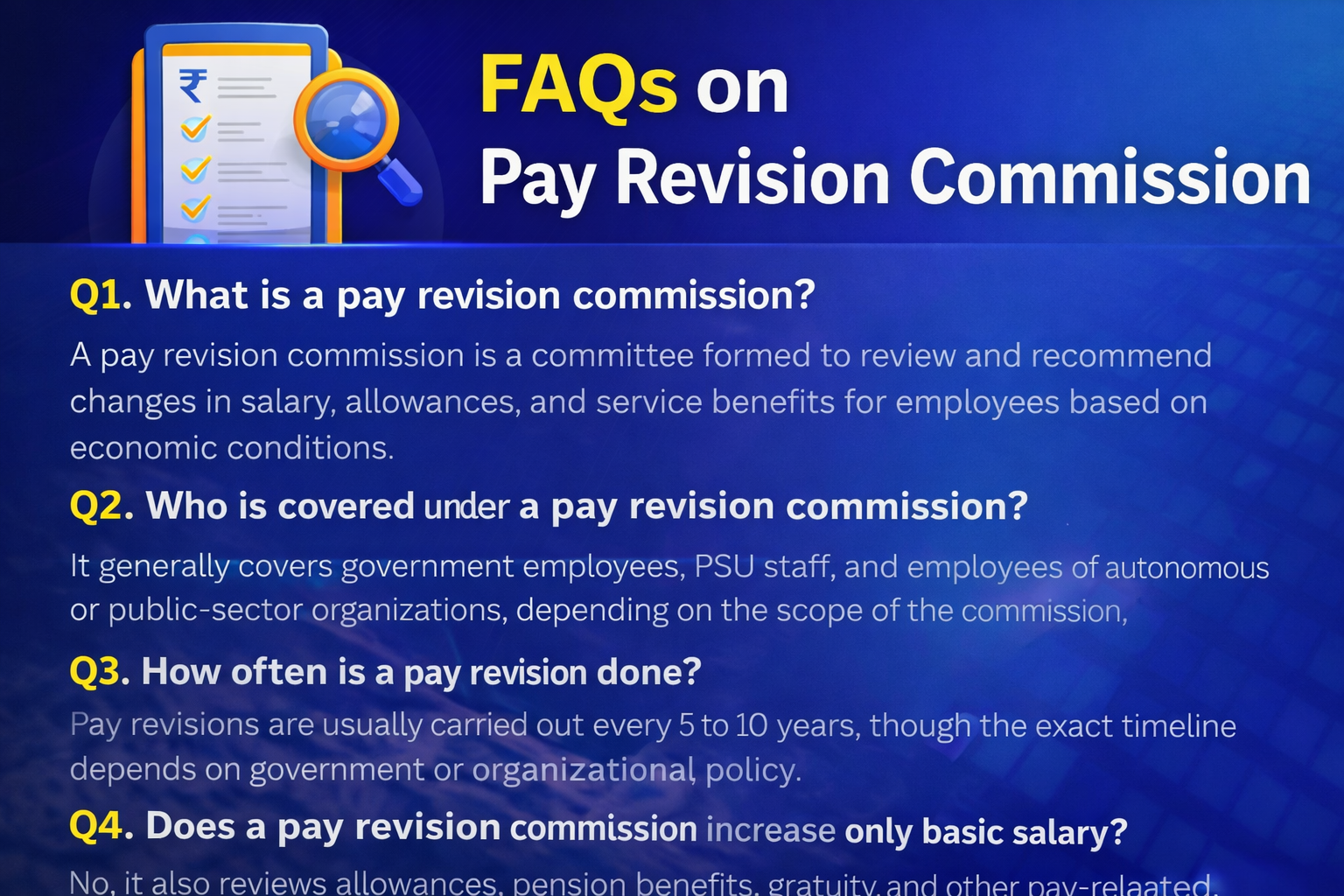
Q1. What is a pay revision commission?
A pay revision commission is a committee formed to review and recommend changes in salary, allowances, and service benefits for employees based on economic conditions.