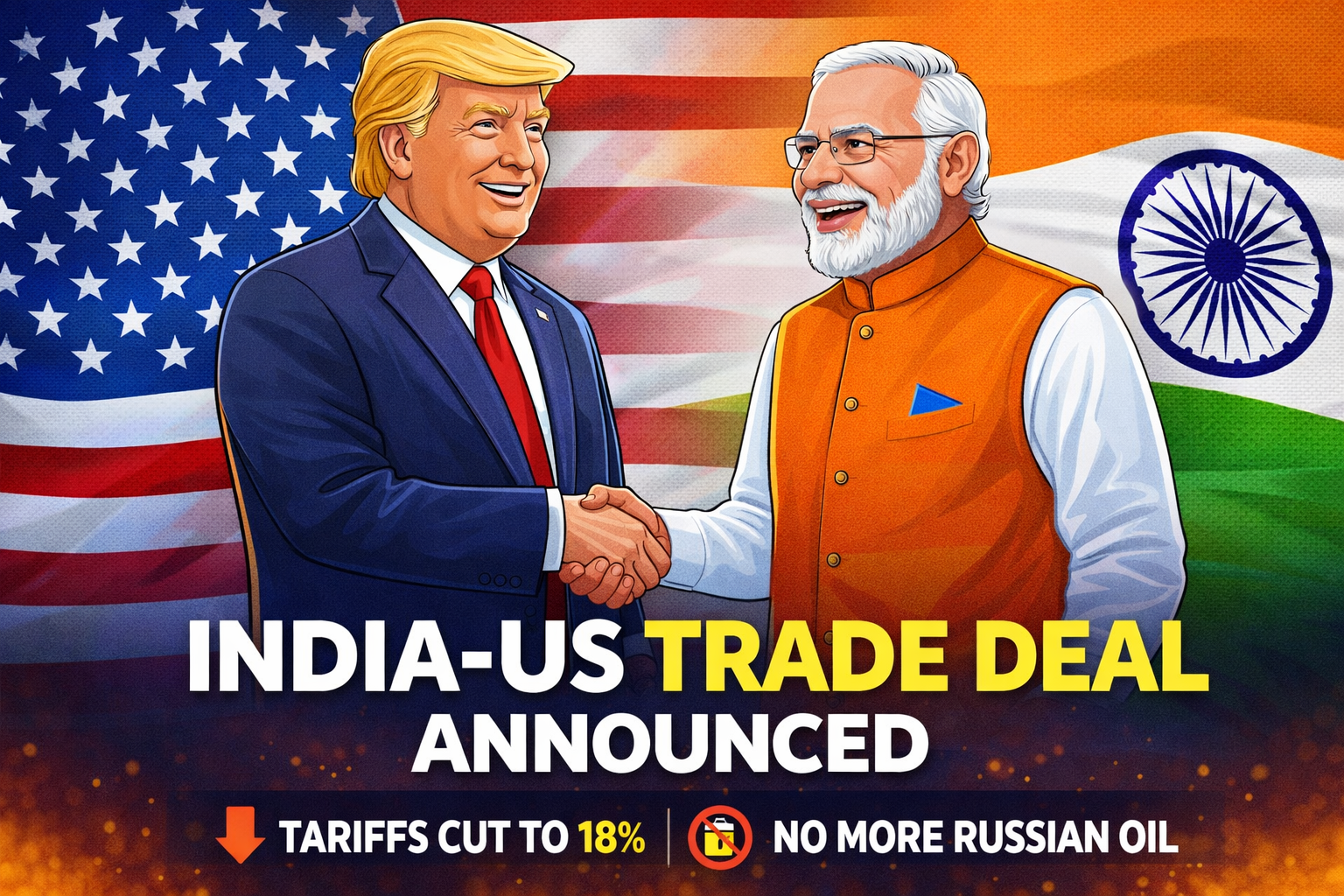
The India-US trade deal announced by President Donald Trump and PM Narendra Modi cuts tariffs to 18% and includes India’s agreement to stop buying Russian oil, reshaping economic ties in 2026.
On February 2, 2026, the United States and India finalized a landmark trade deal following a phone call between U.S. President Donald Trump and Prime Minister Narendra Modi, ending months of negotiations and economic tension between the two countries. This agreement brings key changes to tariffs, trade access, and energy purchasing policies, with far-reaching implications for both nations’ economies.
Key Highlights
- Tariff Cut: U.S. tariffs on Indian goods reduced from 50% to 18%.
- Energy Policy: India agrees to stop buying Russian oil.
- Economic Boost: Potential $500B+ in U.S. goods purchases by India.
- Leaders’ Response: Positive statements from both Trump and Modi.
📉 Tariff Reduction: A Central Pillar of the Deal India-US Trade Deal
Under the newly announced India-US trade deal, the U.S. will immediately reduce its tariffs on Indian goods from high rates to 18%. Earlier, the U.S. had imposed steep tariffs of up to 50% on many Indian products, including a 25% penalty linked to India’s purchase of Russian oil. These trade barriers weighed heavily on exporters in textiles, machinery, leather goods and more, prompting demands for resolution.
The new agreement signals a significant easing of trade friction and is expected to lower costs for Indian exporters to the U.S. market, boosting competitiveness and market access.
Also Read :- SG60 Vouchers
India’s Agreement on Russian Oil Purchases India-US Trade Deal
A defining aspect of the deal is India’s reported commitment to stop buying Russian crude oil — a move that directly addresses U.S. concerns and trade pressures. Part of the earlier U.S. tariff regime targeted Russia-linked oil imports, which accounted for a large portion of India’s energy imports over recent years.
In exchange for adjusting its energy sourcing strategy, India gains tariff relief and expanded trade cooperation with the United States, including potential increases in American energy, technology and agricultural exports to India. Reports suggest this could involve hundreds of billions of dollars’ worth of U.S. goods being purchased by India over time.
Leaders’ Reactions and Diplomatic Dynamics
Both Trump and PM Modi publicly welcomed the trade agreement. Trump described the deal as a product of mutual respect and partnership between two of the world’s largest democracies, praising Modi as a decisive leader. Modi expressed gratitude for the tariff changes and highlighted the benefits this pact would bring to India’s economy.
The leaders’ remarks reflect a strategic pivot in U.S.–India economic relations, which had been strained by tariff disputes and differing trade priorities in recent years.
Market Impact and Economic Outlook
Following the trade deal announcement, Indian financial markets reacted positively, with key indices and stocks expected to open higher as reduced tariffs loosened a significant export cost burden. The promise of increased U.S. market access has been cited as a boost to investor confidence and economic growth prospects.
Industry analysts suggest that this deal may unlock future cooperation in sectors such as technology, energy, agriculture, and services, while also reinforcing India’s role as a major trading partner in the global economy.
Broader Geopolitical Implications
Beyond trade metrics, the agreement also signals shifting geopolitical alignments, particularly in how India manages its energy sources and diplomatic relationships. By moving away from Russian oil purchases, India aligns more closely with U.S. pressures and global sanctions frameworks linked to the war in Ukraine, while also exploring alternate sources such as U.S. and Venezuelan energy supplies.
The trade deal adds to a broader trend of India diversifying its international trade partnerships, including recently concluded agreements with other major partners like the European Union.
The India-US trade deal of 2026 represents a major shift in economic cooperation between New Delhi and Washington, marked by tariff reductions, trade concessions, and energy sourcing commitments. By lowering tariffs to 18% and addressing contentious issues such as Russian oil imports, the agreement has the potential to reshape bilateral trade, stimulate market confidence, and strengthen strategic ties over the coming years.
Source :- Times of India
What is Gift Nifty
GIFT Nifty is a USD-denominated derivatives contract (futures) based on the Nifty 50 index (which tracks the top ~50 companies on the National Stock Exchange of India).
What does the 18% tariff mean for India?
An 18% tariff means the U.S. will charge a reduced tariff rate on Indian exports, which can help boost India’s exports to the American market and improve trade relations between the two countries.
What did the US Ambassador to India say about tariffs on Indian goods?
The United States Ambassador to India, Sergio Gor, confirmed that the total tariff on Indian goods will be 18%, marking a major reduction from previous levels.