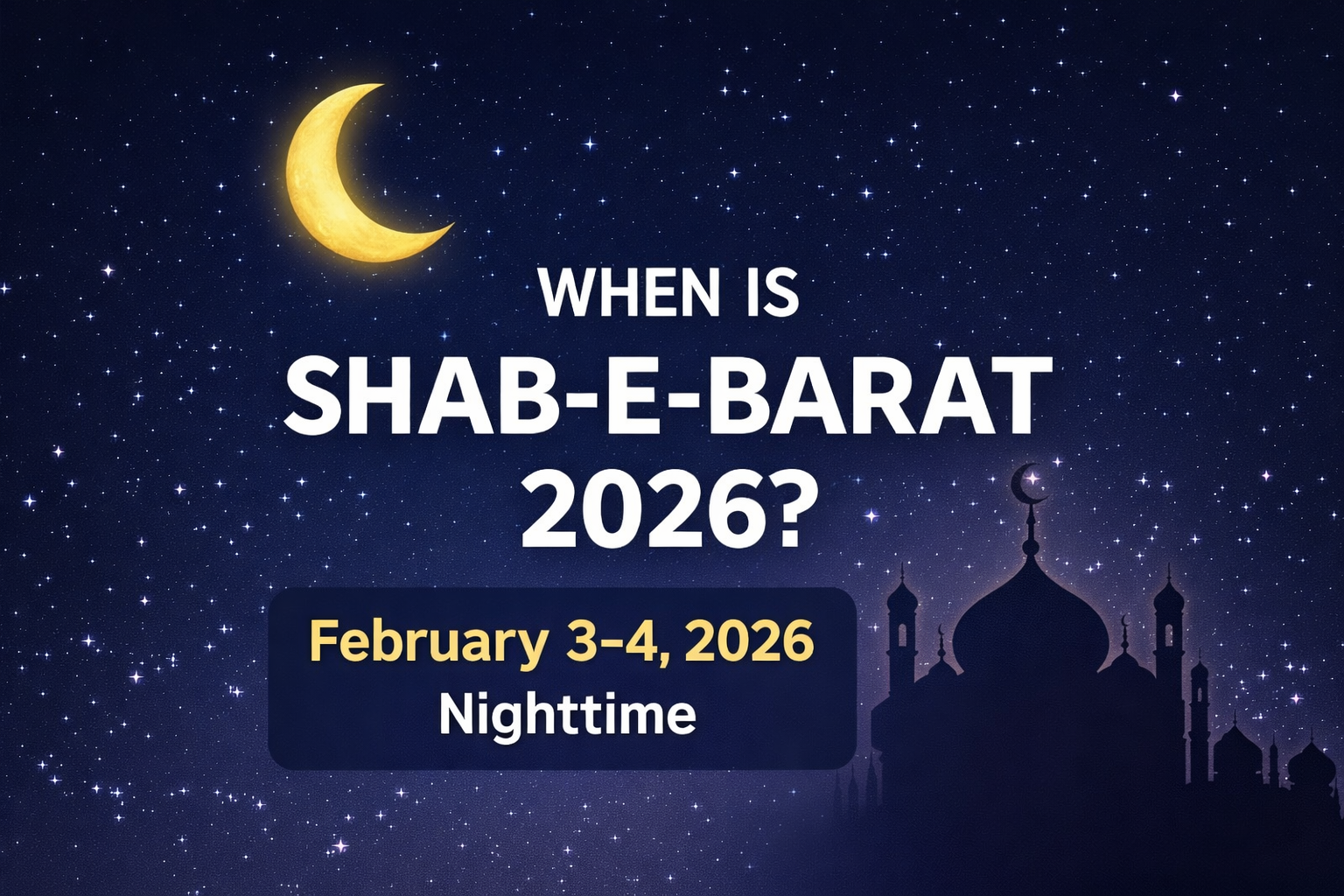
Shab-e-Barat 2026 — observe the 15th night of Sha’ban on February 3–4 with prayers, fasts and spiritual reflection. Learn its correct date, meaning, history and importance in Islam.
Shab-e-Barat is one of the most sacred nights in the Islamic lunar calendar, observed with deep spiritual devotion by millions of Muslims around the world. Often referred to as the Night of Forgiveness or Night of Salvation, this revered occasion falls on the 15th night of Sha’ban — the eighth month of the Islamic year — and is marked by prayer, reflection, seeking forgiveness and preparing spiritually for the upcoming month of Ramadan.
📅 When Is Shab-e-Barat 2026?
In 2026, Shab-e-Barat will be observed on the night corresponding to 15 Sha’ban 1447 AH, which — depending on local moon sighting — falls on:
- Tuesday night, February 3, 2026, extending until dawn on Wednesday, February 4, 2026 in most regions including India, Pakistan and Bangladesh.
Islamic days begin at sunset, so in some places the sacred night begins after Maghrib (sunset) on February 3 and continues until Fajr (dawn) on February 4.
What Is Shab-e-Barat?
Shab-e-Barat — also called Laylat al-Bara’ah, Nisfu Sha’ban, or simply Mid-Sha’ban — is traditionally regarded by many Muslim communities as a night when Allah’s mercy and forgiveness are especially accessible.
The name combines:
- “Shab” (Persian for “night”)
- “Barat” (Arabic meaning “pardon”, “salvation” or “innocence”)
This rich linguistic heritage reflects the night’s essence as a time for:
- Seeking forgiveness for past and future sins,
- Praying for mercy and blessings,
- Reflecting on one’s life, intentions and spirituality.
Also Read :- SG60 Vouchers
🕌 Significance & Traditions
Shab-e-Barat holds deep spiritual meaning and is often associated with the following beliefs:
- Many believers hold that Allah decides people’s destinies for the coming year on this night, based on their past deeds and supplications.
- It is considered an auspicious time to turn back to Allah through worship, Quran reading, voluntary fasts (especially on the day of 15 Sha’ban), Istighfar (seeking forgiveness), and extra prayers.
- Some traditions suggest the night is ideal for praying for deceased relatives and asking Allah to grant them mercy.
While some Muslim scholars consider these practices deeply meaningful, others emphasize focusing on established acts of worship, noting differences in opinions over specific rituals tied to this night.
How Shab-e-Barat Is Observed
Across many Muslim communities:
- Mosques hold late-night congregational prayers
- Individuals spend time in reflection, Du’a (supplication) and Quran recitation
- Many believers also engage in voluntary fasts on the day following the night
- Acts of charity (Sadaqah) and asking forgiveness from others feature strongly in the night’s spiritual focus.
Whether observed quietly at home or in congregation at the mosque, Shab-e-Barat remains a time for deep connection with faith and hope for divine mercy.
🌙 Why It Matters Before Ramadan
Shab-e-Barat comes shortly before Ramadan, the holiest month in the Islamic calendar. For many Muslims, this night serves as a spiritual warm-up for Ramadan, encouraging believers to renew their faith, purify their intentions and prepare for the heightened devotion that Ramadan demands. As such, it holds a unique place in the rhythm of Islamic observances.
🧠 Final Thoughts
In 2026, the 15th night of Sha’ban — Shab-e-Barat — will be celebrated with prayer, fasting and spiritual reflection from the evening of February 3 until dawn on February 4. Though practices and exact observance times may vary by region and moon sighting, the night’s central theme of seeking forgiveness and divine mercy remains a cornerstone of the faithful’s devotion.
Source :- Google